Recently, I had a discussion with a writer who'd included Zoroastrianism with pagan and Wicca. I have nothing against pagan or Wicca, but found it surprising that the writer was unfamiliar with Zoroastrianism's founding influence on the world's primary faiths:

Zoroastrianism is a religion founded in ancient times by the prophet Zarathushtra, known to the Greeks as Zoroaster.
Zoroastrianism was the dominant world religion from 559 BCE to 651 CE, and was thus the most powerful world religion at the time of Jesus. It had a major influence on other religions and is still practiced world-wide.
Those other religions that Zoroastrianism influenced?
Western Abrahamic (Judaism, Christianity, Islam) and Eastern Dharmic (Hinduism, Buddhism, Jainism, Sikhism) religious traditions, including God, the Devil, sexual equality, evolution, environmentalism, and, my personal favorite, free will...
What is
Zoroastrianism?
"Zoroastrianism is the oldest of the revealed world-religions, and it has probably had more influence on mankind, directly and indirectly, than any other single faith." - Mary Boyce, Zoroastrians: Their Religious Beliefs and Practices (London: Routledge and Kegan Paul, 1979, p. 1)
"Zoroaster was thus the first to teach the doctrines of an individual judgment, Heaven and Hell, the future resurrection of the body, the general Last Judgment, and life everlasting for the reunited soul and body. These doctrines were to become familiar articles of faith to much of mankind, through borrowings by Judaism, Christianity and Islam; yet it is in Zoroastrianism itself that they have their fullest logical coherence....” - Mary Boyce, Op. Cit. p. 29.
http://www.avesta.org/avesta.html
[Zoroastrian] Relation to other religions and cultures
Zoroastrianism is uniquely important in the history of religion because of its formative links to both Western Abrahamic and Eastern Dharmic religious traditions.
Some scholars (Boyce, 1987; Black and Rowley, 1987; Duchesne-Guillemin, 1988) assert that key concepts of Zoroastrian eschatology and demonology are evident in the Abrahamic religions, for instance in the Asmodai of Judaism.
[snip]
For example, one of the popular strains within Zoroastrianism considers both good and evil as creations of God. According to historians, this is a doctrine that influenced Christianity and notwithstanding the great deal of exposition in order to not compromise Zoroaster's otherwise coherent concept of Free Will, has a widespread following...
Why is Zoroastrianism important today?
Zoroastrianism, though small in number of adherents, is the original religion of tens of millions of Shi'a Iranians, Sunni Kurds and the Parsee of India. These populations still celebrate Zoroastrian holidays, still honor their Zoroastrian roots and, in many cases, have expressed a yearning to go back to the precepts which were noted for their tolerance of other faiths and commitment to coexistence, a point of view that is lacking in many parts of the regions where they live:
Many aspects of Zoroastrianism are in turn present in the culture and mythologies of the peoples of the Greater Iran, not least because Zoroastrianism, for a thousand years, was a dominant influence on the people of the cultural continent. Even after the rise of Islam and the loss of direct influence, Zoroastrianism remains part of the cultural heritage of the Iranian language-speaking world, in part as festivals and customs [...] which in turn is pivotal to Iranian identity.
If you want to understand the Iranians, the Kurds, the Parsi of India and the source concepts of the religions that both east and west call their own, an exploration of Zoroastrianism can be invaluable.
Zoroastrian Environmentalism
Zoroastrianism is, first and foremost, a environmentalist religion. The purity of the earth, water and air is paramount to the founding precepts and the adherents are bound, by scripture, to protect nature in all its glory. This is also evidenced by Zoroastrianism's specific holidays, which fall on the equinoxes and solstices, as celebrations of the natural cycles of the earth (more on this below).
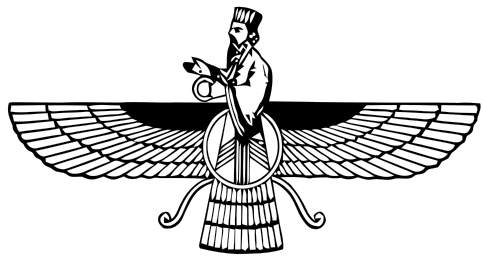
 Faravahar Symbol
:
The Faravahar, a winged disc with a man's upper body, the symbol of the Zoroastrian religion, is thought to represent the guardian spirit who sends one's soul into the material world to fight the battle of good against evil.
Note: Prior to the reign of
Darius the Great (522 to 485 BCE), the Faravahar showed only the winged disc. The figure of Darius was added, either at his instruction and/or to honor him, during his lifetime. It is this combined image that has survived as the representative symbol of the faith.
Basic Zoroastrian precepts
- Equalism: Equality of all, irrespective of gender, race, or religion.
- Respect and kindness towards all living things. Condemnation of the oppression of human beings, cruelty against animals and sacrifice of animals.
- Environmentalism: Nature is central to the practice of Zoroastrianism and many important Zoroastrian annual festivals are in celebration of nature: new year on the first day of spring, the water festival in summer, the autumn festival at the end of the season, and the mid-winter fire festival.
- Hard work and charity: Laziness and sloth are frowned upon. Zoroastrians are encouraged to part with a little of what would otherwise be their own.
- Loyalty and faithfulness to "family, settlement, tribe, and country."
From the scripture
On Evolution: "How is existence brought about? Just as one substance is evolved out of another according to its own laws and in the finite time."
On Action: "A thousand people cannot convince one by words to the extent that one person can convince a thousand by action."
On Religious Education: "It is the desire of Ahura Mazda [God] from people is this: 'Know me', for he knows: 'If they know me, everyone will follow me'. The desire of Angra Mainyu [the Devil] is this: 'Do not know me', for he knows: 'If they know me no one will follow me'."
Zoroastrianism's most sacred prayer
The Ahunwar (in Avestan):
ýathâ ahû vairyô
athâ ratush ashâtcît hacâ
vanghêush dazdâ mananghô
shyaothananãm anghêush mazdâi
xshathremcâ ahurâi â
ýim drigubyô dadat vâstârem!!
Translation:
The will of the Lord is the law of righteousness.
The gifts of Vohu-mano [humanity] to the deeds done in this world for Mazda [God].
He who relieves the poor makes Ahura [God] king
He who relieves the poor makes Ahura [God] king...And then there are those ancient legal codes within the
Avesta that prohibited slavery, allowed for anyone, king to poorest, to bring another before a court, required that men were responsible for women they impregnated (and the child) throughout their lifetimes, codified that women could own land and divorce without question, prohibited animal and human sacrifice and on and on and on.........
More on the basics beliefs
The supreme being is called Ahura Mazda (Phl. Ohrmazd), meaning "Wise Lord." Ahura Mazda is all good, and created the world and all good things, including people. He is opposed by Anghra Mainyu (Phl. Ahriman), meaning "Destructive Spirit," the embodiment of evil and creator of all evil things. The cosmic battle between good and evil will ultimately lead to the destruction of all evil.
The scripture of Zoroastrianism is called the Avestam, which consist of the following five books:
- Yasna: Sacred Liturgy and Gathas/Hymns of Zarathushtra
- Khorda Avesta: Book of Common Prayer
- Visperad: Extensions to the Liturgy.
- Vendidad: Myths, code of purification, religious observances
- Fragments
The most sacred section is in the Yasna (Chapter 1):
I profess myself a Mazda-worshipper and a Zoroastrian, opposing the Daevas, accepting the Ahuric doctrine. ...I praise good thoughts, good words, and good deeds and those that are to be thought, spoken, and done. I do accept all good thoughts, good words, and good deeds. I do renounce all evil thoughts, evil words, and evil deeds.
Within the Yasna are the Hymns of Zarathushtra (also known as the Gathas). These are beautiful poems that are enigmatic, requiring a lifetime of study and thought to come to an understanding of the layers of teachings written by Zoroaster himself; of which, the following are the basic beliefs:
- There is one God, Ahura Mazda, the one uncreated Creator to whom all worship is directed.
- Ahura Mazda's creation - truth and order - is the antithesis of chaos - falsehood and disorder.
- Active participation in life through good thoughts, good words and good deeds (Humata, Hukhta, Hvarshta) is necessary to ensure happiness and to keep the chaos at bay.
- The malevolent is represented by Angra Mainyu, the "Destructive Principle".
- Ahura Mazda will ultimately prevail over Angra Mainyu, after which, all souls of the dead will be brought from darkness and reunited with God.
Here's that bit from the scripture (Zoroaster's own words) that I like:
"It is the desire of Ahura Mazda from people is this: 'Know me', for he knows: 'If they know me, everyone will follow me'. The desire of Angra Mainyu is this: 'Do not know me', for he knows: 'If they know me no one will follow me'"
That quote is not so difficult to figure out. Zoroaster is saying that Ahura Mazda [God] wants people to know him because, if they do, they will follow him, whereas the Angra Mainyu [the angry spirit] does not want people to know him, because if they did, they would not follow him.
Zoroaster was not often that direct in the Gathas. If fact, he was rarely that clear. To understand him, his writings need to be read in Avestan and mulled over for years to get any idea, at all, as to their meaning.
Even then, one can go back and find more meanings in the words, due to the nuance and complexity of the Avestan language, a nuance that exists in the resultant Indo-European languages that followed (Farsi, Kurdi, etc), making it imperative that one understands both the context and the idioms if they seek to obtain an accurate translation (more on language below).
The five sacred books were followed by multiple texts written centuries after Zoroaster's death. These additional books, while revered, are perceived as commentary -- since they were not written by Zoroaster -- rather than sacred (something that has been misinterpreted by some in western academia who have taken precepts from the additional texts as the source religion).
These text are known as the Middle Persian or Pahvlavi
texts and comprise over a thousand years of thought.
Religious observancesReligious observances include the wearing of sacred garments, a sudreh (shirt) and kusti (cord or belt). There is a cleansing ritual known as the Padyab, where an adherent reties the kusti several times a day with another short ritual called the Nirang-i Kusti.
Prayer is in the Avestan language and is performed several times a day either facing fire or the sun as representative of the spirit of God.
Birthdays are honored and celebrated with gifts and ritual, as are the birth of children, which includes gifts to both the mother and child.
There are several festivals throughout the year (mostly falling on equinoxes and solstices). The modern Newroz (New Year) festival in both the Iranian and Kurdish culture is a primary Zoroastrian event.
A black Zoroastrian skullcap, known as a fenta, is thought to have influenced the use of the kippah (yarmulke) in Judaism, as well as the head coverings in both the Catholic and Islamic faiths.
Death and cleansing ritualsEarly Zoroastrianism was specific in its requirement to preserve the purity of earth, water and fire. As they saw the body as a vessel for one's spirit, the flesh, upon death, was seen as unclean, because it decomposed. To bury it or burn it was, to them, a form of pollution.
Therefore the cleansing ritual (this is a bit ewwww) was a form of recycling where they left the body out to be picked clean by carrion, after which they would bury the bones which were considered purified.
Note that, with the exception of the Parsi in India, the practice is not followed as strictly in the Zoroastrian diaspora.
Sexual Prohibitions and ResponsibilitiesThere are admonitions against sex with a women during menstruation, rape and sodomy; similar to the same prohibitions you see in the Bible.
The difference is the responsibility the perpetrator had toward those he involved and/or violated. This is a very interesting part of the religion, in that, if a man impregnated a woman (rape or not), he was responsible for her and her child's well being
for life.
The sodomy prohibition was interesting, as well, in that it prohibited the practice among Zoroastrians (the punishment was a lashing), while it was specified that such judgment was not allowed against anyone who was not Zoroastrian, as they had a right to their own beliefs and practices.
You see this point of view throughout the scripture and the precepts; the requirement that Zoroastrians neither judge nor evangelize against other belief systems, which led to a tolerant religious environment and coexistence between faiths that was hitherto unseen in the ancient world.
Fire (Asha)There has been some confusion about whether Zoroastrians worship fire. They do not. Fire is seen as a representation of the spirit of God, not as a deity in itself. It is called a symbol of "Asha," which translates as "original light of God" and consecrated flames are kept burning in major temples as a sign of esteem for the Asha.
Zoroastrian Temple at Yazd, Iran
Monotheism
The beginning and the end, the creator of everything which can and cannot be seen, the Eternal, the Pure and the only Truth. In the Gathas, the most sacred texts of Zoroastrianism and thought to have been composed by Zoroaster himself, the prophet acknowledged devotion to no other divinity besides Ahura Mazda
There is debate as to whether Zoroastrianism is a monotheistic or dualistic religion. Zoroastrians consider it monotheistic because Ahura Mazda is specified as the only and supreme god. Others cite the fact that Ahura Mazda and his opponent Angra Mainya (which means angry spirit/destructive principle) being perceived as uncreated beings locked in a battle of good vs. evil, means that Zoroastrianism is a dualistic faith.
Zoroastrians point out that Zoroaster's writings, the Gathas; the first poems of the Zoroastrian scripture and the only part of the scripture known to be written by Zoroaster himself, specifies Ahura Mazda as the one god and that such suppositions are misinterpretations of the later texts.
Zoroastrians also point out that, as dualism means worshiping more than one god, and since they would never worship an angry spirit that is equivalent to the devil, the designation does not apply to them anyway.
Not in dispute: Zoroastrianism was the only other religion of its time (approx 1700-1000 BCE) to believe in a single omniscient and supreme being besides Judaism; at a time that the Hebrew tribes were still forming their beliefs. Those beliefs had an opportunity to influence one another in the sixth century, BCE, when the tribe of Judah was exiled to Babylon by Nebuchadnezzar (hanging gardens' fame), where their leading citizen, Daniel (of the Lion's Den Fame) interacted with the Zoroastrian king of Anshan (Iran), Cambyses I, his son, Cyrus the Great and Cyrus' successor, Darius the Great.
It was at that time, when the first ten books of the Bible were being transcribed from the tribe's oral history to text, that many Zoroastrian precepts were thought to have entered the belief systems of the tribe of Judah in Babylon and of the lost tribe of Ephraim, which was in Anshan (Iran) following their exile from Israel years earlier by the Assyrian King,
Tiglath Pileser III (their descendants being Iranian Jews).
Influence on other religions and societiesAs specified above, Zoroastrianism is thought to have greatly influenced Judaism, specifically through the prophet Daniel's close association with the Achaeamenid kings (Cambyses I, Cyrus the Great, Cambyses II and Darius the Great).
Two locations claim Daniel's tomb. One, in Kirkuk, is venerated by the Iraqi Kurds who see Daniel as a great man who both served and influenced their Zoroastrian ancestors. The other is in Susa, the former king seat of Darius the Great, in southwestern Iran; a place where Daniel is known to have lived when he was in Darius' service as an adviser to his court.
It is interesting to note that Iranians still lay flowers on Daniel's tomb. They do the same with the tomb of Esther, the Jewish wife of Xerxes the Great. They are aware that the founder of Iran, Cyrus the Great, returned the tribe of Judah from their enslavement in Babylon to the city of Jerusalem, along with the funds to rebuild their temple and a promise of protection; a promise which he and his predecessors kept until their overthrow by Alexander the Great two centuries later.
It is also interesting that Iran's major holidays are almost all Zoroastrian events. The influence of Zoroastrianism on Islam and the Iranian culture is profound. Again, the quote from the
wiki:
Many aspects of Zoroastrianism are in turn present in the culture and mythologies of the peoples of the Greater Iran, not least because Zoroastrianism, for a thousand years, was a dominant influence on the people of the cultural continent. Even after the rise of Islam and the loss of direct influence, Zoroastrianism remained part of the cultural heritage of the Iranian language-speaking world, in part as festivals and customs but also because Ferdowsi incorporated a number of the figures and stories from the Avesta in his epic Shāhnāme, which in turn is pivotal to Iranian identity.
In addition, Zoroastrianism is thought to have influenced eastern Dharmic religions such as Hinduism, Buddhism, Sikhism and Jainism. This is expressed through the Vedic texts of Dharma, a Sanskrit word that means both 'fixed decree, law, duty' and 'natural law, reality':
Like the historical Vedic religion, which is the historical predecessor of Hinduism, Zoroastrianism also derives from the religious principles of Indo-Iranian times. As such, and although Zoroastrianism is not considered a Dharmic religion, it is not surprising to find fundamental concepts similar to dharma and rta in the [earlier] Gathas as well.
"The prophet Zarathushtra, son of Pourushaspa, of the Spitaman family, is known to us primarily from the Gathas, seventeen great hymns which he composed and which have been faithfully preserved by his community. These are not works of instruction, but inspired, passionate utterances, many of them addressed directly to God; and their poetic form is a very ancient one, which has been traced back (through Norse parallels) to Indo-European times. It seems to have been linked with a mantic tradition, that is, to have been cultivated by priestly seers who sought to express in lofty words their personal apprehension of the divine; and it is marked by subtleties of allusion, and great richness and complexity of style.
Boyce - Zoroastrians, Their religious beliefs and practices, London, 1979, pg 17.
Zarathushtra (Zoroaster in the Greek form) is generally accepted as a historic figure. Most schools of thought place him around 1200 BCE, though many Zoroastrians cite him as having been born around 1750 BCE, either of which would make him the founder of the earliest religion based on scripture (others put him as early as the 18th and as late the 6th centuries BCE). The Greeks identified him as a Bactrian because he preached in the Aria province of Iran (near Afghanistan), thought there is dispute about that as his birthplace.
[The Gathas] include many rote details of his life, such as a record of his family members: His father was Pourushaspa Spitāma, son of Haecadaspa Spitāma, and his mother was Dughdova. He and his wife Hvōvi had three daughters, Freni, Pourucista, and Triti; and three sons, Isat Vastar, Uruvat-Nara, and Hvare Ciθra. Zoroaster’s great-grandfather Haēcataspa was the ancestor of the whole family Spitāma, for which reason Zoroaster usually bears the surname Spitāma. His wife and children, and a cousin named Maidhyoimangha, were his first converts after his illumination from Ahura Mazdā at age 30.
Zoroaster is reported to have lived a hermetic lifestyle as a child. He is thought to have been born either near the Dhraja River (Aria province of Iran) or by the River Araxes near the northwest frontier of the Medes. Legend says that he laughed at his birth and spent much of his childhood in reflection.
Zoroaster's first converts were his family, including his wife's aunt, Queen Hutaōsa (Atossa) of Bactria, whom, along with his daughter, Pourucista, was influential in spreading the word of his scripture.
Atossa was also a royal name in the line of the Achaeamenids, given to both the sister and daughter of Cyrus the Great, pointing to either a name of honor or the possibility that the Achaeamenids might have claimed descent from Zoroaster's line itself (although there is no evidence to support that one way or the other).
Zoroaster left the court of Queen Hutaōsa and King Vištaspa of Bactria, to preach his scripture to ordinary people; a new concept in a world where religion was thought to have been the purview of a privileged theocratic class.
The
Shahnameh, which translates as the "Book of Kings," an epic poem written by the Persian poet, Ferdowsi, states that Zoroaster was murdered at the altar by the Turanians (Nomadic tribes of Central Asia) during their the conquest of Balkh (Mazari Sharif in Afghanistan).
After his death, Zoroaster's teachings were continued by his daughter, Pourucista and her husband, Jamshid, as an an oral tradition that was initially committed to writing during the Achaeamenid (Cyrus and Darius) period and then fully committed to text under the Sasanians; rulers of the third Iranian empire.
Zoroastrianism, the religion as revealed by the prophet Zoroaster would go on to become the predominant world religion for a thousand years, until the rise of Islam pushed it into the subconscious and cultural memory of the Iranian and Kurdish peoples.
Zoroastrianism also followed the Iranian exiles, those who fled Islamic persecution and forced conversion, east to India. These exiles are now known as the
Parsi a close knit Zoroastrian community that is one of the few to hold on to all the old rituals and to follow the scripture as written.
Zoroastrianism in Western AcademiaMuch of the western understanding of Zoroastrianism comes from the early Greek writers, most specifically, Herodotus. This presents a problem because both he had reason to overlook the positive in favor of the difference and/or misunderstandings of the faith.
To understand why, it helps to look at what was happening between east and west where he lived.
Herodotus was from Ionian Greece (western Turkey) at a time when the Achaeamenid kings, Darius and Xerxes, were campaigning against Greece. During Darius' campaign, the city of Miletus (modern Bodrum), the seat of Greek philosophy, revolted against their Persian overlords and was burned to the ground.
The importance of Miletus cannot be underestimated in the hearts of Greeks. It was the home of
Thales the Sage, the father of philosophy who had opened the first Greek academy of higher learning, where his students included Pythagoras and Anaximander and his colleagues, Solon and Aesop.
To quote Aristotle: All thought began with Thales.
Needless to say, after that, the Greeks were not inclined to publicized positive information about their adversaries' faith.
In addition, there has been some confusion in reading the sacred texts (the first five books of Zoroaster) as also including the later Pahlavi texts, rather than seeing the latter as commentary and religious studies.
Zoroastrianism, Avestan, and the Cuneiform of KingsMy understanding of Zoroastrianism comes through both my own exposure to the faith and seven years of research I did for a book I am writing. To facilitate that research I learned the language of the Zoroastrian scripture, Avestan, along with several forms of cuneiform used by the Achaeamenid and Babylonian kings (old Parsan, Elamite and Akkadian).
From the cuneiform inscription on Darius' tomb:
Ahura Mazda, when he saw this earth in commotion, thereafter bestowed it upon me, made me king; I am king. By the favor of Ahura Mazda I put it down in its place; what I said to them [my subjects], that they did, as was my desire.
There are many cuneiform inscriptions tying the kings to their Zoroastrian beliefs, with quotes that are both an expression of faith and of power, but it was Avestan, the language of the Zoroastrian scripture, that surprised me the most. Not only because I found it to be a beautiful languge, filled with nuance and subtlety that required patience and thought upon interpretation. But also because it turned out that Avestan is the root Indo-European language for English, Greek, German and Kurdish, among many other. This became clear through words such as (note the nuance in the different definitions):
Humata: Well thought out, well planned, human.
Anaiwyâstô: Ungirded, without holy garments (the Kusti), inexperienced.
Patha: way, road, spiritual path.
Angra: hostile (angry), evil, bad.
Patar: Father.
Here's a link to the
Avestan Dictionary for those who would like to explore this very important source language.
Noted ZoroastriansThe most well known Zoroastrians are not even known as Zoroastrians. These are the three wise men, the Magi, from the bible who brought presents to Jesus at his birth. The Magi were the priestly caste of the Medes (Kurds) who were the clerics of the Zoroastrian faith within their culture.
Other noted Zoroastrians include Cyrus the Great and his successors, conductor Zubin Mehta, singer Freddy Mercury, actor Erick Averi (
list).
Zoroastrianism todayWhile there are a small (and dwindling) number of actual adherents worldwide, the direct influence of Zoroastrianism (beyond the influence on other religions) is surprisingly large.
As mentioned above, Zoroastrianism is an archetypal foundation belief system of millions of Iranians, including those who follow Islam. Their holidays are Zoroastrian, they still lay flowers on the tombs of the Zoroastrian kings, Cyrus the Great, Darius the Great and on Daniel's and Esther's tombs, as well.
Therefore, it is possible that Zoroastrian precepts are one way to reach Islamic extremists in the Iranian culture, as they might be willing to go back to the more tolerant axioms of Zoroastrianism if they received encouragement; but not if it is misrepresented or disrespected.
The existence of the same founding precepts could be said for over 30 million Kurds. They are very close to their Zoroastrian roots, very proud of that heritage (many still follow the
Gathas of Zoroaster) and that's over 30 million with an M.
Zoroastrian Adherents
Small Zoroastrian communities are found in India (the Parsis), Pakistan, Iran, as well as major urban areas in United States, Canada, United Kingdom, Australia, and a worldwide diaspora.
There are estimated to be between 140,000 and 200,000 Zoroastrian hereditary adherents worldwide. The small number is because, in its most strict interpretation, Zoroastrianism requires one being born into the religion. As that interpretation has led to a significant decrease in numbers, there is increasing pressure among less orthodox Zoroastrians to allow conversion to increase the base.
This is a difficult decision because Zoroastrianism does not evangelize, as it would violate one of the founding precepts, tolerance and acceptance of other beliefs; a precept that made the early Persian king, Cyrus the Great, exceedingly popular when it became clear that to live under his rule meant to be respected for and left alone with one's own beliefs.
SummaryZoroastrianism is a
founding belief system acknowledged to have heavily influenced both
Abrahamic (Judaism, Christianity, Islam) and
Dharmic (Hinduism, Buddhism, Jainism and Sikhism) religions.
It is a religion of tolerance and respect for environment that is dwindling in numbers because they neither evangelize nor allow conversion. There are Zoroastrians who are arguing for conversion, as there are many who wish to join the faith in this time of intolerance and climate change. There are no Zoroastrians, however, who argue for evangelizing the faith, as it is against precepts to judge another's belief system as lessor to one's own.
Even with it's small numbers of adherents, however, Zoroastrianism's influence is profound, especially among tens of millions of Iranians, Kurds and the Parsi of India. As such, it is one possible way to reach the more extreme members of the religions that followed and bring some of them back to the early tolerance of their original faith, as it is a founding principle of their cultures, one whose precepts of equality, environmentalism and coexistence could be of benefit to all the regions of the world.
More information about Zoroastrianism:
Avesta -- Zoroastrian ArchivesWiki on Zoroastrianism
Livius (Dutch author Jona Lendering's incredible historical site) on the:
Avesta,
Zoroastrianism,
Zoroaster, the
Achaeamenids and his complete index on
Persia.
Recommended reading: Mary Boyce,
ZoroastriansFrederick Nietzsche:
Thus Spake Zarathustra (this is fiction and not recommended as a religious text or commentary -- just put here for reference).

 SUBSCRIBE
 RSS
RSS